Toward Ultra-Large-Scale Quantum Computing: Inter-Cryostat Quantum Links
2026.05.23As quantum processors continue to scale up, a fundamental question arises: if a single cryostat can no longer accommodate enough qubits or provide sufficient cooling power, can we distribute QPUs across multiple cryostats and establish quantum links between them?
This is the central idea behind an inter-cryostat quantum link. It is not simply a matter of connecting two cryogenic instruments with ordinary cables. Rather, it requires building a channel in a millikelvin environment that can transmit microwave photons, quantum states, or entanglement.
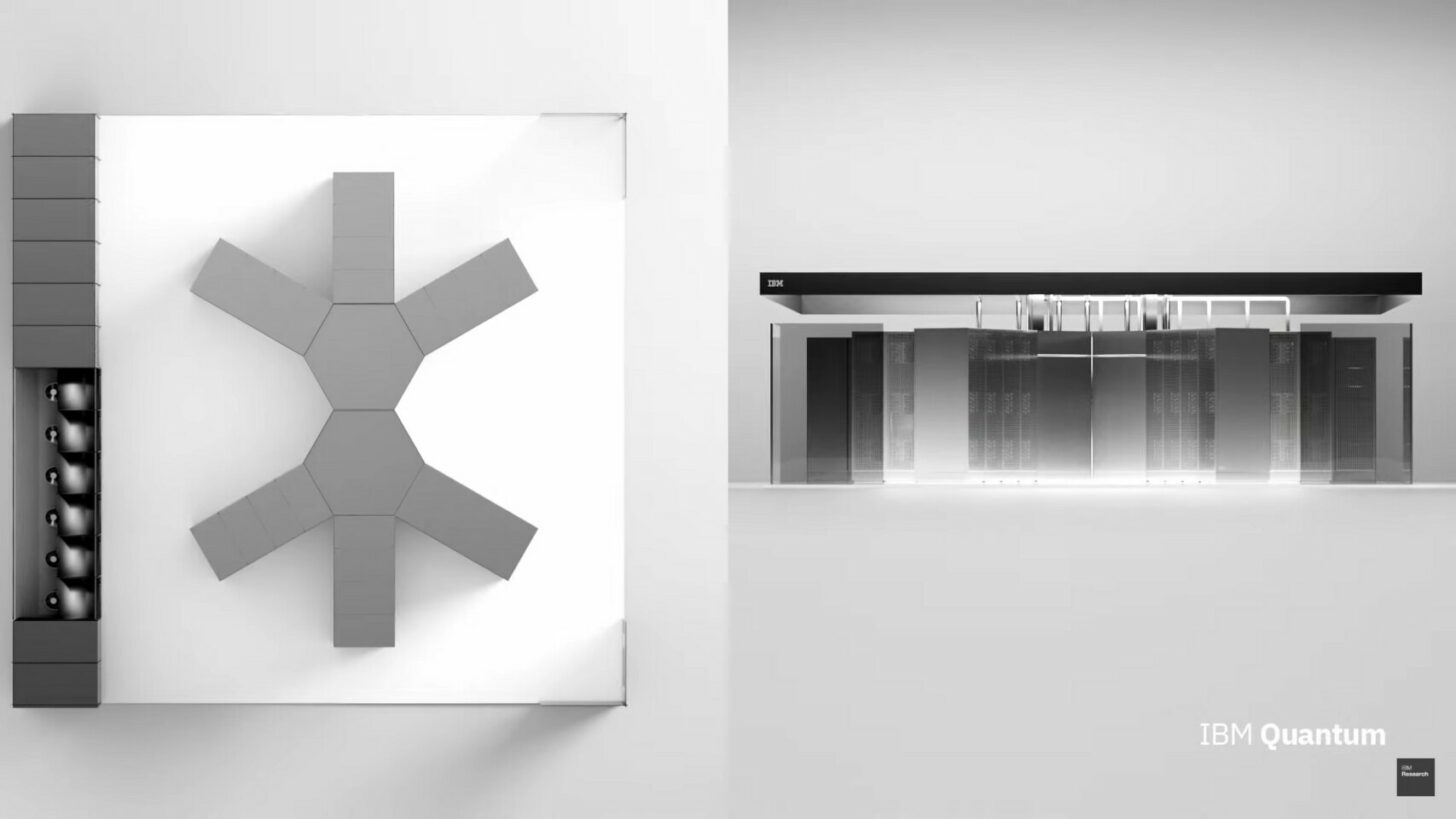
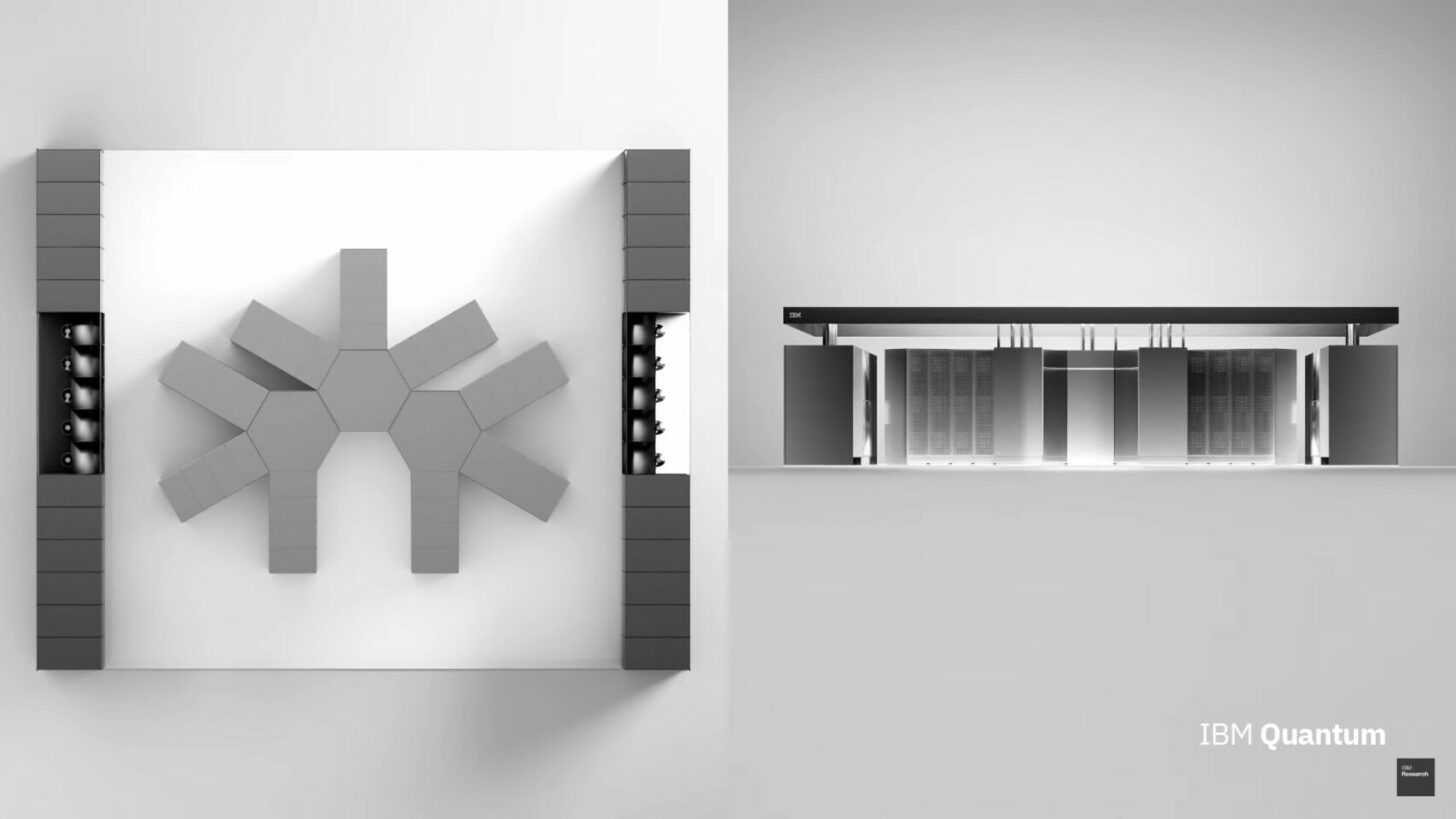
▲ Conceptual renderings of IBM’s Quantum System Two modular quantum system. When a single QPU or a single cryogenic system is no longer sufficient to meet the required computational scale, future systems may integrate multiple QPU modules through both classical connections and quantum connections.
Ref: https://wccftech.com/ibm-intros-osprey-quantum-processor-over-400-quantum-bits-to-power-quantum-system-two/
Why Do We Need Inter-Cryostat Quantum Links?
Superconducting qubits typically operate in an ultralow-temperature environment of around 10–20 mK. Each qubit requires control lines, readout lines, filters, attenuators, isolators, amplifiers, and calibration resources. As the number of qubits increases, the bottlenecks are not limited to whether the chip itself can be made larger. Cryostat volume, cooling power, cryogenic wiring density, microwave crosstalk, packaging architecture, and system calibration complexity all become major constraints.
Therefore, an important path toward ultra-large-scale quantum computing is to divide the overall quantum system into smaller, maintainable, and replaceable QPU modules. Each module can be housed in its own cryostat, and these modules can then be combined into a larger computing system through quantum links. This architecture is analogous to server clusters in data centers.
Microwave Quantum Channels
For superconducting quantum circuits, the typical operating frequencies of qubits lie in the microwave regime. Therefore, for short- to medium-range inter-cryostat links, a common research direction is to use cryogenic microwave channels, such as low-loss coaxial cables, waveguides, cryogenic circulators, directional couplers, and quantum nodes capable of controllably emitting and absorbing microwave photons.
Ordinary cables transmit classical signals formed by the collective motion of many electrons. As long as the signal strength is sufficient and noise is manageable, information can be transmitted reliably. A quantum link, however, may need to transmit a single-photon wave packet or a quantum state carried by a microwave photon. In this case, any loss, thermal noise, reflection, or phase drift can directly destroy the quantum information.
| Channel Requirement | Physical Meaning |
|---|---|
| Low Loss | If a microwave photon is absorbed during transmission, the quantum state it carries is lost. |
| Low Thermal Noise | Thermal photons can contaminate the quantum channel, making it difficult for the receiver to distinguish the intended quantum signal from environmental noise. |
| Impedance Matching | If impedance discontinuities exist in the channel, microwave photons may be reflected, reducing transmission and absorption efficiency. |
| Phase Stability | The phase of a quantum state is itself part of the information. Therefore, channel length, temperature, and mechanical vibration can all introduce phase noise. |
| Wave-Packet Shaping | The photon wave packet emitted by the transmitter must match the absorption mode of the receiver in order to improve quantum state transfer efficiency. |
| Time Synchronization | The control pulses, readout timing, and receiving windows of the two QPUs must be precisely synchronized. |
Inter-Cryostat Quantum Entanglement
Inter-cryostat quantum-link technology has evolved from chip-to-chip microwave-photon transmission, remote entanglement generation, and cryogenic microwave-channel engineering. The following table summarizes several important experimental milestones.
| Year | Experimental Focus | Significance |
|---|---|---|
| 2018 | Deterministic quantum state transfer and remote entanglement using microwave photons. | Demonstrated that superconducting quantum circuits can emit, transmit, and absorb microwave photons carrying quantum information, establishing an important foundation for distributed superconducting quantum computing. |
| 2020 | ETH Zurich demonstrated an approximately 5 m microwave quantum link. | Pushed microwave quantum channels from the chip scale to the inter-cryostat scale, demonstrating the possibility of coherent links across cryogenic systems. |
| 2023 | Two superconducting circuits separated by approximately 30 m were entangled through a cryogenic microwave channel and used in a Bell test. | Showed that superconducting quantum circuits at macroscopic distances can exhibit nonlocal quantum correlations through engineered microwave channels. |
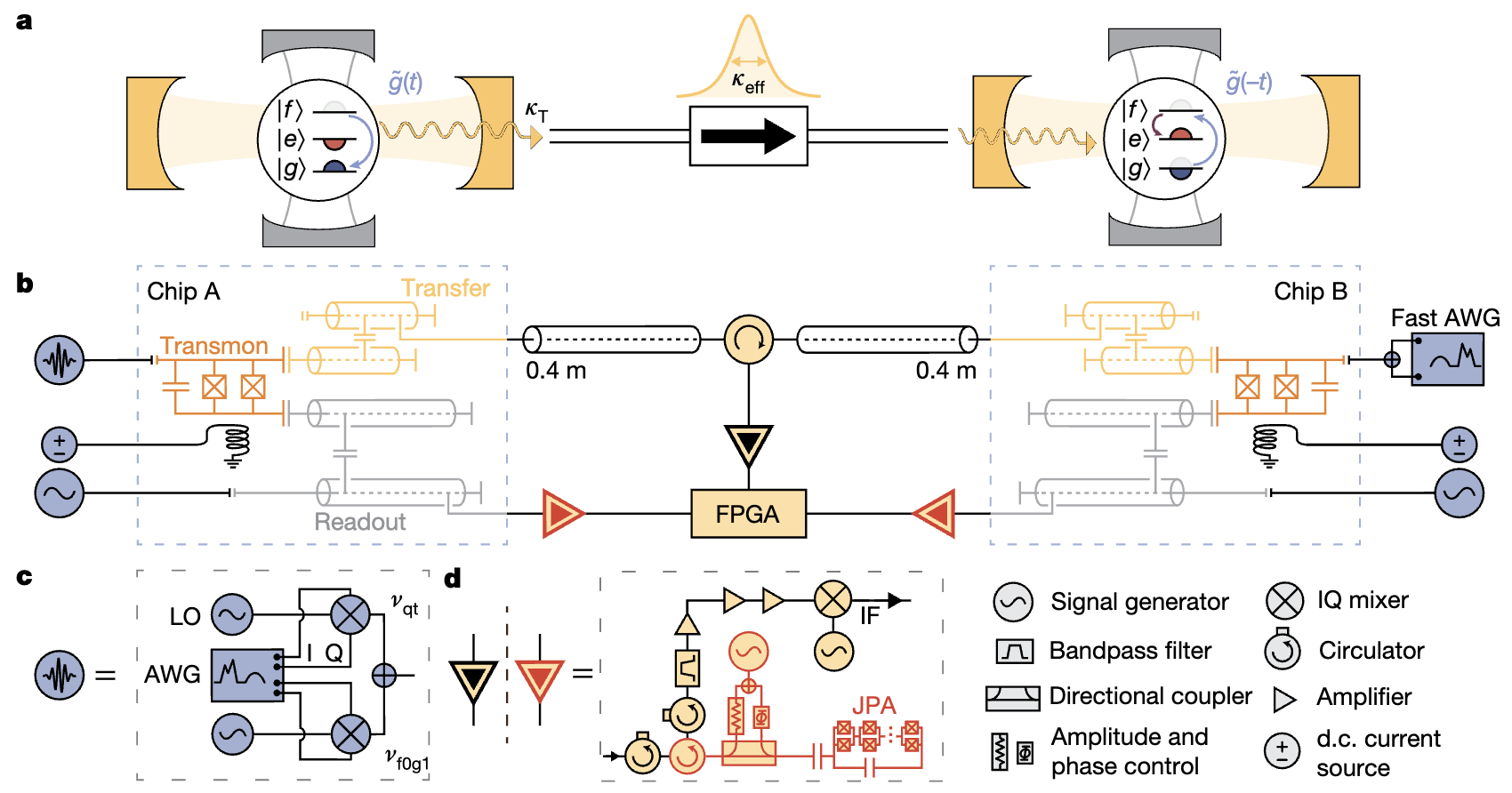
▲ A 2018 Nature paper demonstrated deterministic quantum state transfer and remote entanglement using microwave photons.
The core idea is that a quantum node can convert the state of a qubit into a propagating microwave photon,
which is then absorbed by another node to complete quantum state transfer.
Ref: Deterministic quantum state transfer and remote entanglement using microwave photons, Nature 558, 264–267 (2018), DOI:10.1038/s41586-018-0195-y
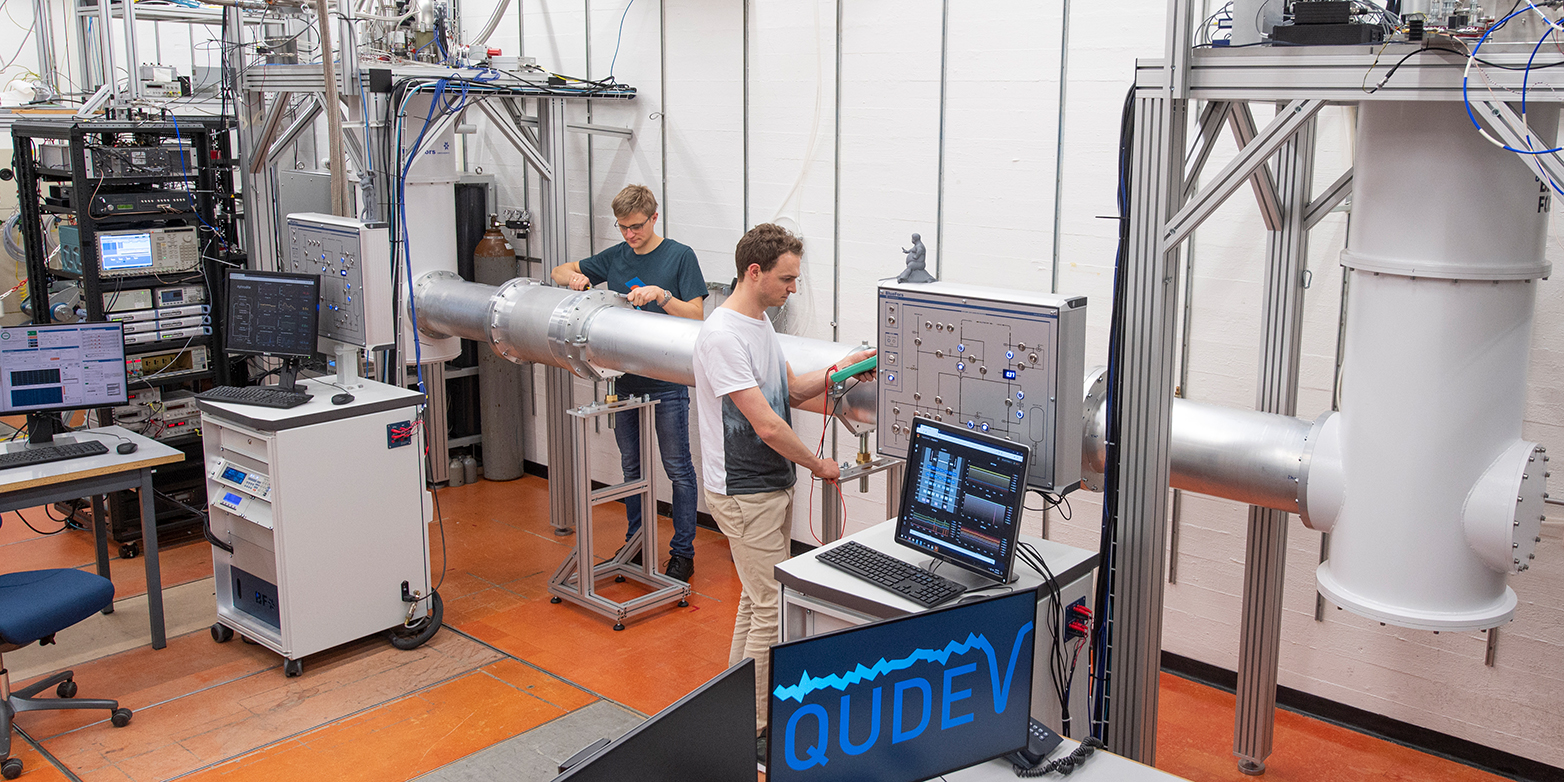
▲ An inter-cryostat microwave quantum-link experiment demonstrated by ETH Zurich.
The image shows a long-distance cryogenic microwave channel and the experimental systems at both ends.
The key objective of such experiments is to maintain coherent transmission of microwave quantum states over meter-scale distances.
Ref: https://ethz.ch/en/news-and-events/eth-news/news/2020/03/longest-microwave-quantum-link.html
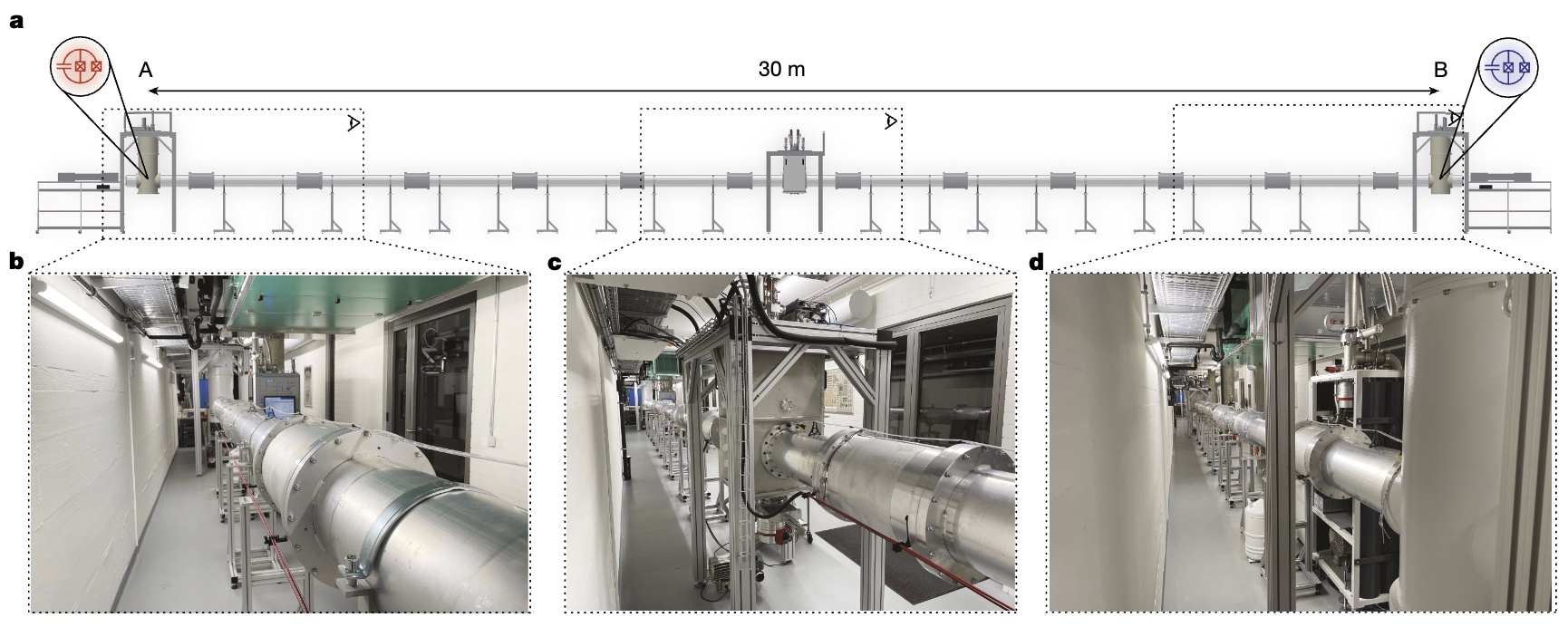
▲ The experimental architecture of a 30 m inter-cryostat superconducting-circuit experiment reported in a 2023 Nature paper, which successfully performed a loophole-free Bell inequality test.
The superconducting circuits at both ends were connected through a long-distance cryogenic microwave channel, showing that inter-cryostat quantum links have moved from concept toward experimentally testable platforms.
Ref: Loophole-free Bell inequality violation with superconducting circuits, Nature 617, 265–270 (2023), DOI:10.1038/s41586-023-05885-0
Hardware Components of an Inter-Cryostat Quantum Link
An inter-cryostat quantum link can be divided into three main parts: a transmitting quantum node, a cryogenic transmission channel, and a receiving quantum node. Each part must integrate cryogenic microwave engineering, quantum control, and time synchronization.
| Hardware Section | Possible Components | Function |
|---|---|---|
| Transmitting Quantum Node | Transmon qubit, tunable coupler, readout/transmission resonator | Maps the quantum state of a local qubit onto a propagating microwave photon wave packet. |
| Microwave Emission Control | Pulse shaping, parametric coupling, Raman process | Controls the temporal shape of the emitted photon so that the wave packet can be efficiently absorbed by the receiver. |
| Cryogenic Transmission Line | Coaxial cable, waveguide, low-loss superconducting transmission line | Transmits microwave photons under low-thermal-noise and low-loss conditions. |
| Nonreciprocal Components | Circulator, isolator, directional coupler | Control the direction of microwave signals and reduce reflections and noise backflow. |
| Receiving Quantum Node | Receiving resonator, transmon qubit, tunable coupler | Reabsorbs the incoming microwave photon and converts it back into the quantum state of a local qubit. |
| Synchronization and Calibration System | AWG, FPGA, clock distribution, phase calibration | Ensures that the pulses, receiving windows, and phase references at both ends are aligned. |
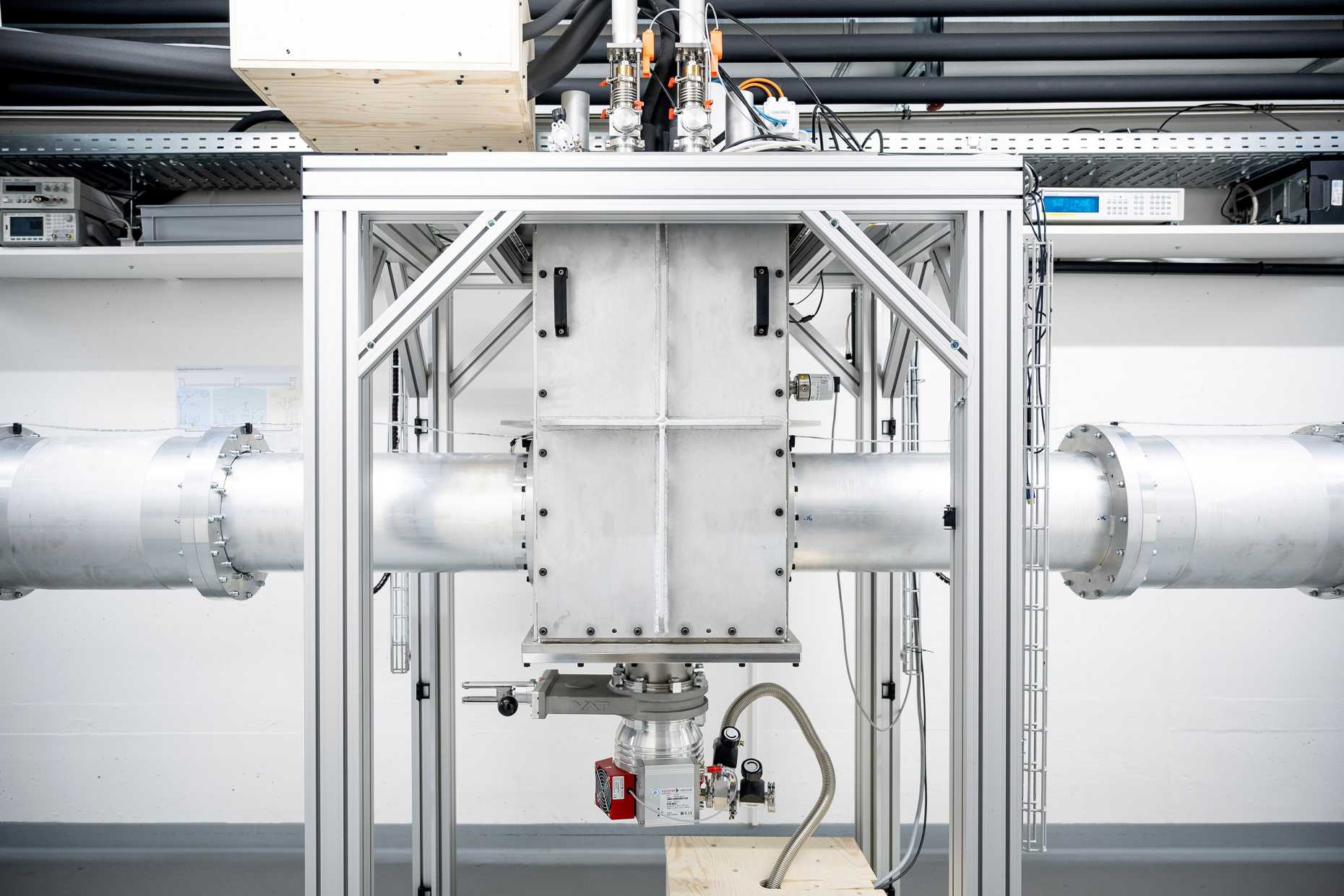
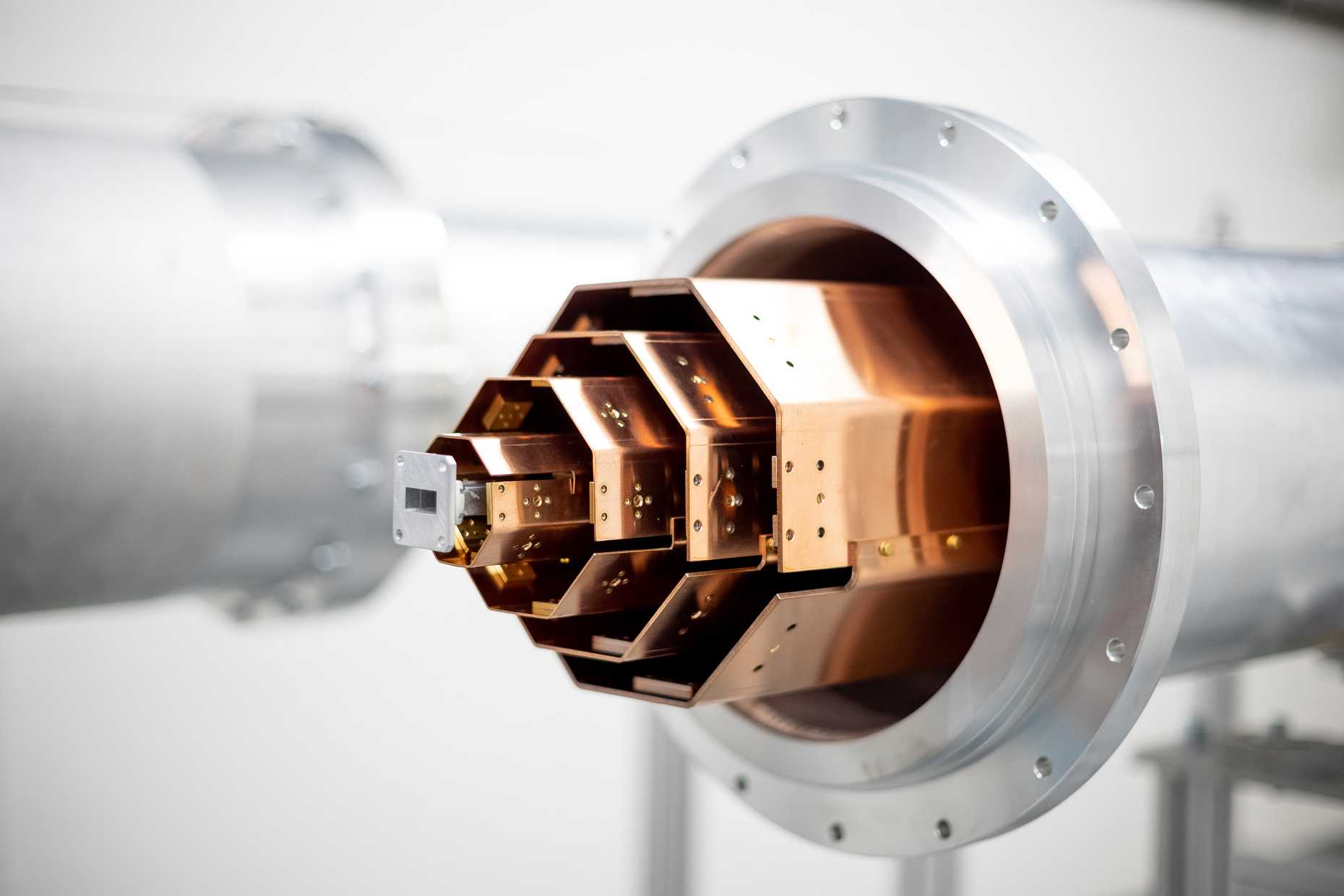
▲ An inter-cryostat quantum link must keep a long-distance transmission line under cryogenic, low-loss, and low-noise conditions.
This makes the quantum link not only a problem in quantum physics, but also one in cryogenic engineering, microwave engineering, and system integration.
The images show an internal view of ETH Zurich’s 30 m quantum-link channel. The aluminum waveguide at the center is cooled to near absolute zero and connects two quantum circuits.
Multiple layers of copper shielding protect the conductor from thermal radiation. For quantum signals at the single-photon level, channel geometry, connectors, reflections, and thermalization all affect quantum transmission efficiency.
Ref: https://ethz.ch/en/news-and-events/eth-news/news/2023/05/entangled-quantum-circuits.html
Photo: ETH Zurich / Daniel Winkler
Technical Challenges
| Key Challenge | Description |
|---|---|
| Transmission Loss | If microwave photons are absorbed or scattered in a long-distance channel, the fidelity of quantum state transfer is directly reduced. |
| Thermal Photon Noise | If thermal radiation from room temperature or higher-temperature stages enters the channel, it can generate spurious microwave signals and destroy the quantum state. |
| Cryogenic Heat Load | Long metallic transmission lines introduce heat. Thermal anchoring, material selection, and multistage cooling are required to reduce the load on the mK stage. |
| Phase and Timing Stability | The phase references and timing of the two QPUs must remain stable; otherwise, remote entanglement and quantum-gate operations will be distorted. |
| Wave-Packet Matching | The transmitter and receiver must precisely control the photon wave packet so that the receiver can absorb it with high efficiency. |
| Integration of Nonreciprocal Components | Circulators and isolators can suppress reflected noise, but conventional components are bulky and may introduce loss or magnetic-field requirements that affect scalability. |
| Modular Calibration | As the number of QPUs increases, each quantum link requires independent calibration of coupling strength, frequency, phase, and delay. |
| Error-Correction Integration | If future inter-cryostat links are to support fault-tolerant quantum computing, they must be integrated with logical qubits, syndrome measurement, and real-time decoders. |
From Quantum Links to Quantum Data Centers
The long-term goal of inter-cryostat quantum links is not merely to demonstrate that two nodes can be entangled, but to enable multiple QPU modules to jointly execute large-scale quantum algorithms. In such an architecture, each dilution refrigerator can be regarded as a quantum-computing node. Multiple nodes can establish entanglement or transmit quantum states through quantum interconnects, while a classical control system handles synchronization, scheduling, readout, and error correction.
This means that future quantum computers will no longer be merely “a single instrument.” Instead, they will resemble quantum-computing architectures composed of cryogenic systems, microwave channels, classical supercomputers, control electronics, real-time decoders, and multilayer software stacks. The key to ultra-large-scale quantum computing will also shift from simply increasing the number of qubits to making spatially distributed quantum modules behave, at the information level, like one programmable quantum system.
Hybrid supercomputer–quantum computing addresses the question of how QPUs can work together with classical supercomputers. Inter-cryostat quantum links address a different question: how multiple QPUs can be connected at the quantum level. Together, these two directions form a complete hardware roadmap toward ultra-large-scale quantum computing.
Originally written in Chinese by the author, these articles are translated into English to invite cross-language resonance.
 Peir-Ru Wang