Superconducting Quantum Computer Winter Workshop
(Feb 4–6, 2026)
Official Event Introduction
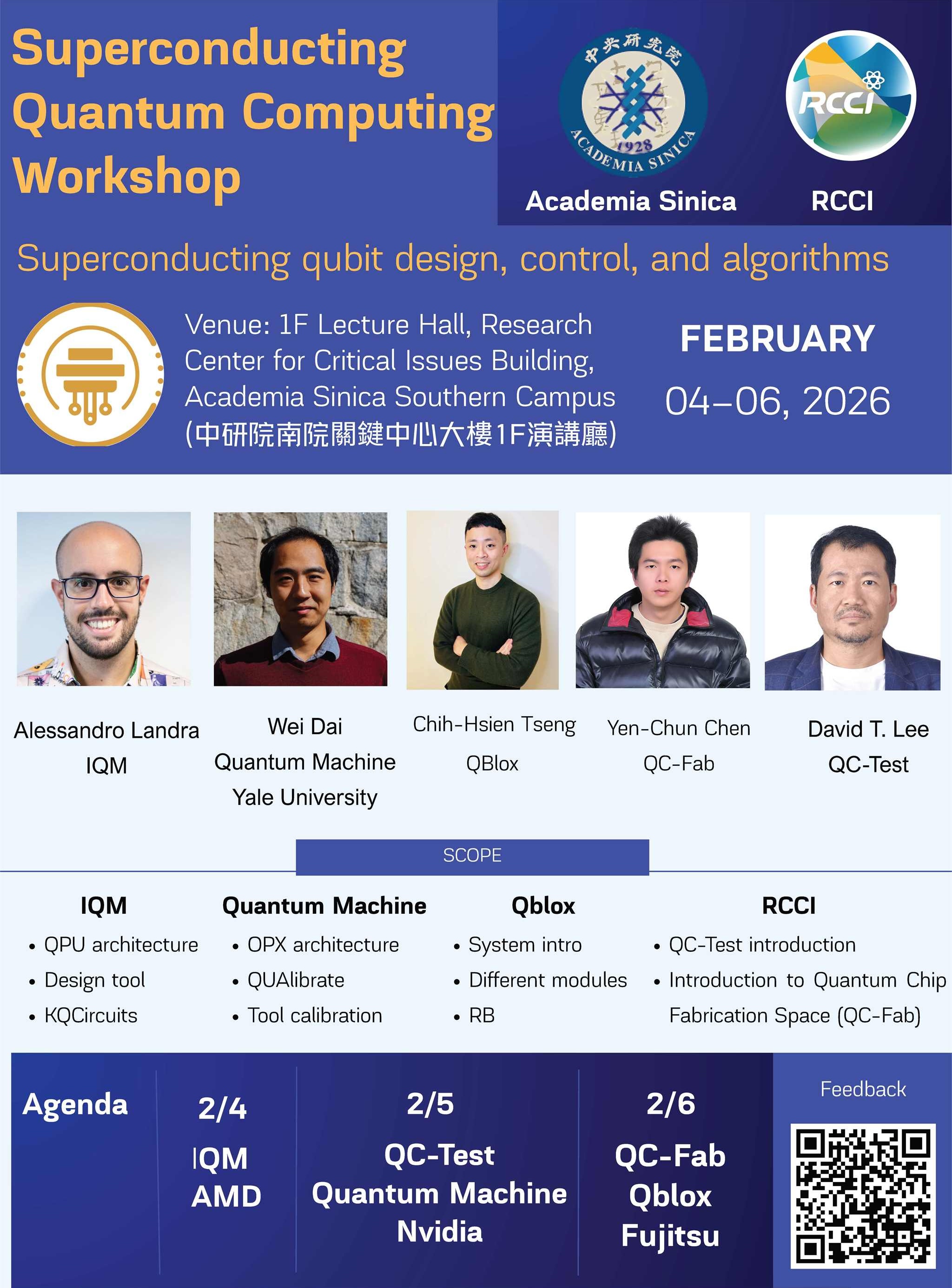
In this winter workshop, we aim to provide hands-on training on QPU control, the qubit design tool, and the various hardware architectures of the systems we use in IQM and QC-test. The trainees will need to bring in their laptops to do the training with the mentors. The mentors will come directly from the system providers, thereby providing the latest updates on their hardware and software. The trainees will be selected through the application system, with prior experience and currently working on superconducting qubits will be considered first. The graduate school and postdoctoral levels are the first consideration. Welcome to your participants.
Agenda

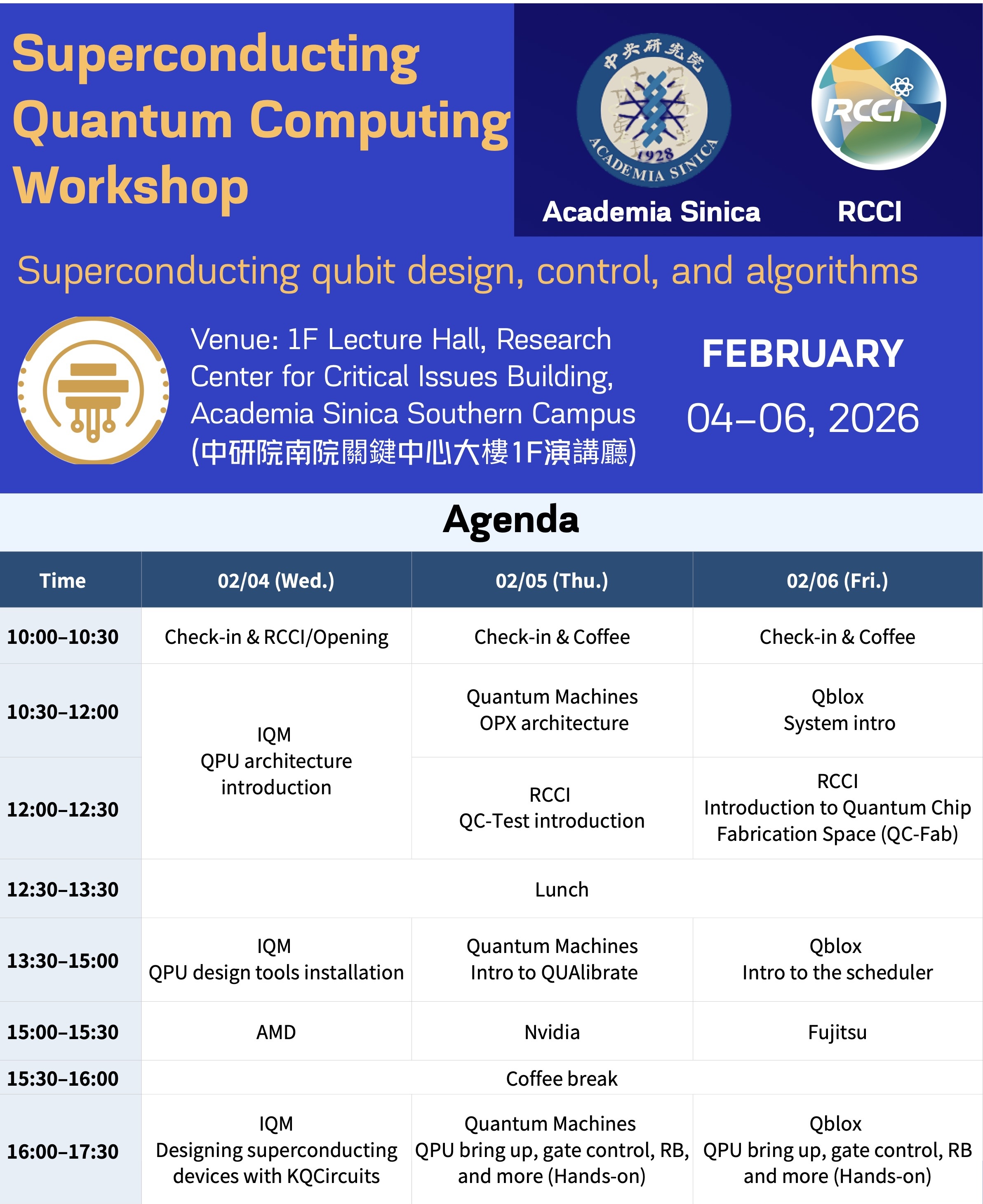
Event Overview
Following the 2025 International Year of Quantum Science and Technology, in early 2026, Academia Sinica announced a 20-qubit quantum chip (press release) and collaborated with an international quantum startup to host this Winter Workshop. The content focuses on educational training for superconducting quantum chip design and real-machine calibration processes. Superconducting qubits are currently the mainstream platform for quantum computers; renowned companies such as Google, IBM, and Amazon all use superconducting qubits as their foundation, and quantum startups like IQM and Rigetti have also begun mass-producing quantum computer prototypes.
Due to the sensitive nature and macroscopic size of superconducting qubits, calibration processes must be executed almost continuously to maintain longer decoherence times and precise operational parameters. Unlike current mainstream (classical) computers that rely on a digital logic architecture, the logic of superconducting quantum circuits is closer to microwave (radio frequency) analog circuits, requiring complex and precise microwave signals for control and measurement. Over the past 30 years, superconducting qubit research has required the integration of numerous AWGs (Arbitrary Waveform Generators), digital-to-analog converters, carrier up-conversion, and other signal modulations. Issues with clock synchronization, integration, and noise among various instruments have often been research bottlenecks. Furthermore, instrument assembly, setup, and electromagnetic circuit environments differ across laboratories, making quantum research highly "customized" (qubit chips fabricated in one laboratory often cannot be transferred to another lab to produce reproducible results). As a result, quantum integrated control manufacturers like Quantum Machines and Qblox have emerged, providing integrated operating interfaces and scalable control/readout modules to assist in quantum research.
Moving towards practical quantum computing (Fault-Tolerant Quantum Computing, FTQC), integrating thousands of qubits on a single quantum chip will be a crucial engineering challenge in the near future. Currently, controlling a single qubit requires more than thirty parameters, while also having to account for interacting gate controls and crosstalk issues—scaling at \(\mathcal{O}(n^2)\)—between n qubits. We often say that quantum computers are expected to provide exponential speedups over classical computers, but in practice, the first challenge encountered is the exponential increase in control complexity. Constantly calibrating tens of thousands of parameter combinations requires real-time GPU acceleration assistance, alongside collaborative development with companies like Nvidia (GPU-accelerated learning) and AMD (FPGA open-source integrated quantum control chips).
Personally, I feel that the arrangement of this Workshop aligns perfectly with the practical development and integration issues of superconducting qubits. The co-organizing vendors will also play important roles in the subsequent development of superconducting quantum computers. This Workshop provides researchers with a comprehensive overview of the developmental landscape in superconducting quantum computing.
Originally written in Chinese by the author, these articles are translated into English to invite cross-language resonance.
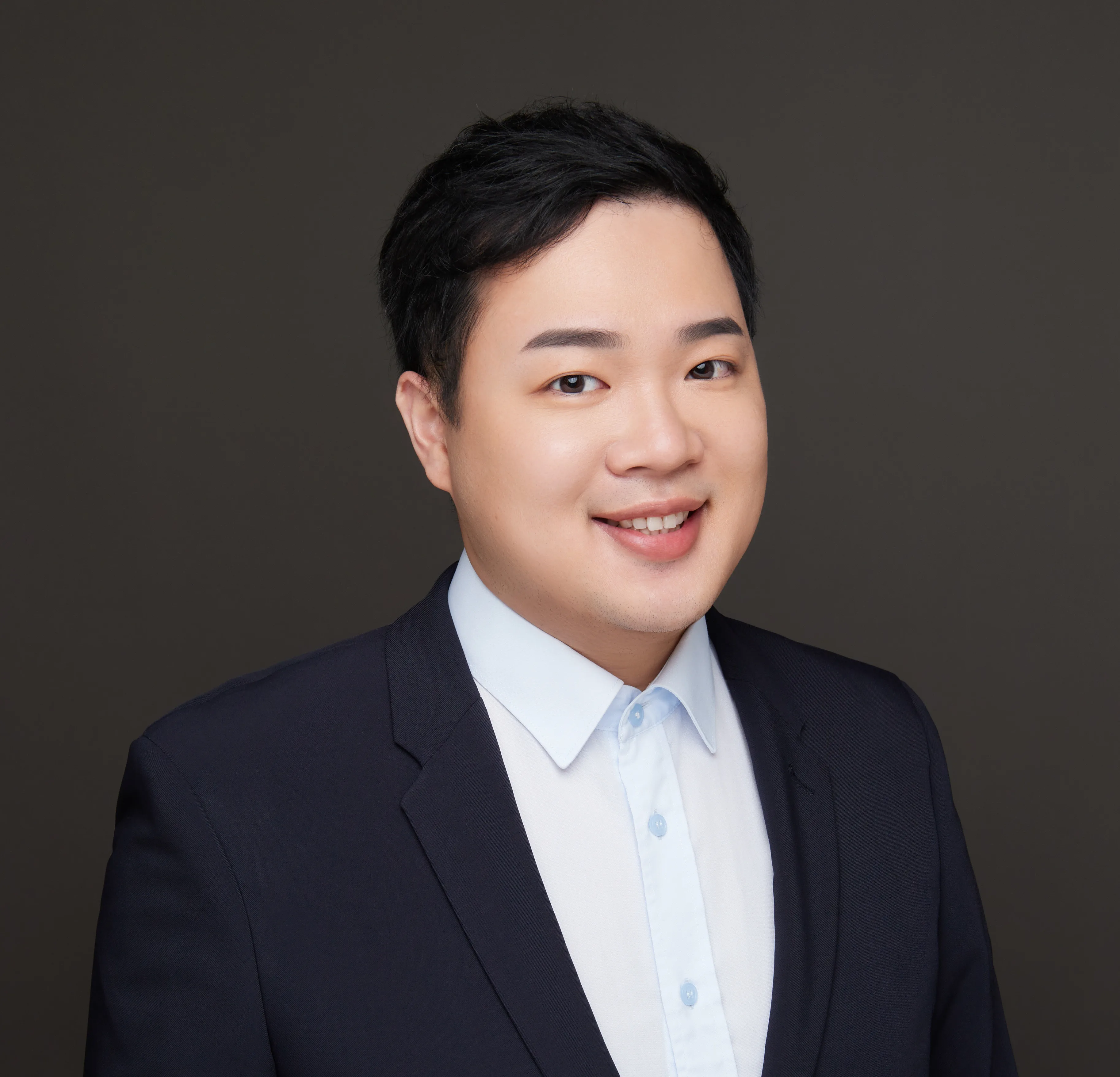 Peir-Ru Wang